New York State Attorney General Sues Coinbase and Gemini
by Marc Fitapelli | April 28, 2026 11:01 pm
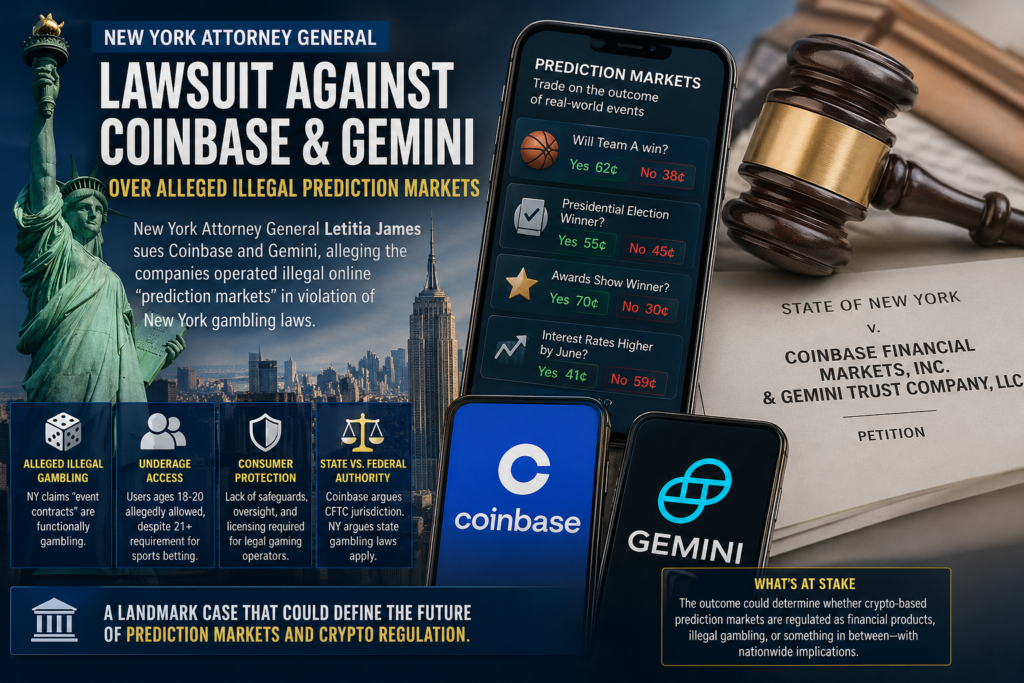
New York Attorney General Letitia James recently filed a significant lawsuit against Coinbase [1]and Gemini [2]alleging that the companies operated illegal online “prediction markets” in violation of New York gambling laws. The lawsuit has attracted national attention because it sits at the intersection of cryptocurrency regulation, online gambling law, financial technology, and consumer protection. The case could ultimately help define how prediction markets will be regulated across the United States for years to come.
Prediction markets are platforms that allow users to speculate on the outcome of future events. These events can include presidential elections, sporting events, entertainment awards, economic indicators, interest rate decisions, and other public developments. Participants generally purchase contracts tied to specific outcomes, and the value of those contracts changes depending on how likely the market believes the event is to occur. Supporters of prediction markets argue that they provide valuable forecasting information and improve market efficiency by aggregating public opinion and knowledge. Critics, however, argue that many of these products are functionally indistinguishable from gambling.
What are the New York AG’s Allegations?
According to the New York Attorney General’s petition, Coinbase and Gemini allegedly offered New York residents access to event-based trading products that effectively allowed users to place wagers on uncertain future outcomes. The State argues that these products fall within New York’s definition of gambling activity regardless of whether they are labeled as “event contracts,” “prediction products,” or financial instruments. The petition alleges that users could speculate on the outcome of sporting events and other future occurrences through platforms that were not licensed under New York’s gaming laws.
The lawsuit also focuses heavily on consumer protection concerns. New York alleges that the companies exposed consumers to the risks associated with online gambling while operating outside the extensive regulatory safeguards imposed on licensed gaming operators. Traditional gambling operators in New York are subject to detailed licensing requirements, age restrictions, compliance obligations, anti-money laundering procedures, and oversight from state regulators. According to the petition, the State believes the defendants attempted to bypass these requirements by characterizing the products as financial trading instruments rather than gambling activity.
One of the more notable allegations in the lawsuit involves age restrictions. The Attorney General claims that certain users between the ages of 18 and 20 allegedly had access to prediction market products even though New York generally requires users to be at least 21 years old to participate in mobile sports wagering. The State argues that this demonstrates a lack of adequate consumer safeguards and further supports its position that the products operate similarly to sports betting platforms.
State v. Federal Law
The case also raises broader questions concerning federal versus state regulatory authority. Coinbase has reportedly argued that at least some prediction market products fall under the jurisdiction of the Commodity Futures Trading Commission (“CFTC”), which regulates derivatives and certain commodities-related financial products at the federal level. This is a central issue in the litigation. If prediction market contracts are treated as federally regulated financial instruments, state regulators may have limited authority to prohibit or regulate them. On the other hand, if courts determine that these products are primarily gambling activity, state gaming laws could apply regardless of how the products are structured.
This legal battle is particularly important because the cryptocurrency industry has increasingly attempted to blur the line between traditional finance, decentralized finance, online gaming, and speculative event trading. Cryptocurrency exchanges and fintech companies continue to introduce innovative products that do not fit neatly into existing regulatory categories. Regulators across the country have struggled to determine whether these products should be governed by securities laws, commodities laws, gaming laws, banking regulations, or some combination of all four.
The outcome of the case may also affect companies beyond Coinbase and Gemini. Numerous cryptocurrency platforms, decentralized applications, and blockchain-based prediction market systems have emerged in recent years. Some operate through centralized exchanges, while others rely on decentralized protocols that claim to function without direct corporate control. Regulators have become increasingly concerned that these platforms could allow users to engage in large-scale speculative gambling activity without sufficient oversight, licensing, or consumer protections.
New York has historically taken an aggressive approach toward cryptocurrency regulation. The State’s BitLicense framework, administered by the New York Department of Financial Services (“NYDFS”), already imposes significant compliance obligations on cryptocurrency businesses operating within New York. Attorney General James has repeatedly stated that cryptocurrency companies must comply with existing laws regardless of how novel their products may appear. The prediction market lawsuit is consistent with New York’s broader effort to subject digital asset businesses to strict regulatory scrutiny.
Prediction Market Supports Arguments
Supporters of prediction markets argue that the lawsuit could stifle innovation in financial technology and decentralized systems. Some economists and academics have long argued that prediction markets provide valuable forecasting tools that can improve decision-making and market efficiency. For example, prediction markets have historically been used to estimate election outcomes, economic performance, and public sentiment with surprising accuracy. Proponents contend that these markets are fundamentally different from traditional gambling because they may provide useful informational value rather than pure entertainment.
Critics disagree and argue that the practical reality is much simpler: users are risking money on uncertain future outcomes in hopes of making a profit. Regulators also worry that these products may contribute to compulsive gambling behavior, especially when marketed through highly accessible smartphone applications and cryptocurrency trading platforms. Concerns regarding addiction, financial harm, underage participation, and market manipulation have become central themes in the government’s case.
The lawsuit may also create substantial compliance concerns for fintech startups and cryptocurrency exchanges seeking to expand into event-based financial products. Depending on how the courts rule, companies may need to obtain gaming licenses, register with federal regulators, restrict access by state, or significantly redesign their platforms. Some businesses may determine that the legal uncertainty surrounding prediction markets outweighs the potential financial benefits of offering such products.
For consumers and investors, the litigation highlights the importance of understanding the regulatory status of emerging cryptocurrency products before participating. Many digital asset platforms operate across multiple jurisdictions with rapidly changing legal requirements. Products marketed as innovative investment tools may nevertheless face legal challenges if regulators believe they resemble gambling, unregistered securities offerings, or unlawful derivatives trading.
As these disputes continue to evolve, businesses and consumers may increasingly seek guidance from a prediction market attorney familiar with cryptocurrency law, gaming regulations, securities law, CFTC enforcement, and consumer protection statutes. Attorneys working in this area must often navigate overlapping regulatory frameworks involving both state and federal agencies. Because the law surrounding prediction markets remains unsettled, legal advice can be critical for companies attempting to structure compliant products and for consumers seeking to understand their rights.
The New York lawsuit against Coinbase and Gemini represents more than a dispute over cryptocurrency products. It reflects a broader struggle over how emerging financial technologies will be regulated in the modern economy. Courts and regulators are now being asked to determine whether prediction markets are innovative financial tools, unlawful gambling operations, or some hybrid of both. The answer could reshape the future of cryptocurrency exchanges, decentralized finance, online gaming, and speculative trading markets nationwide.
- Coinbase : https://mdf-law.com/coinbase/
- Gemini : https://mdf-law.com/gemini-exchange/
Source URL: https://mdf-law.com/new-york-state-attorney-general-sues-coinbase-and-gemini/