The Ledger Hack: What Crypto Wallet Users Should Know
by Staff Attorney | May 6, 2026 12:04 pm
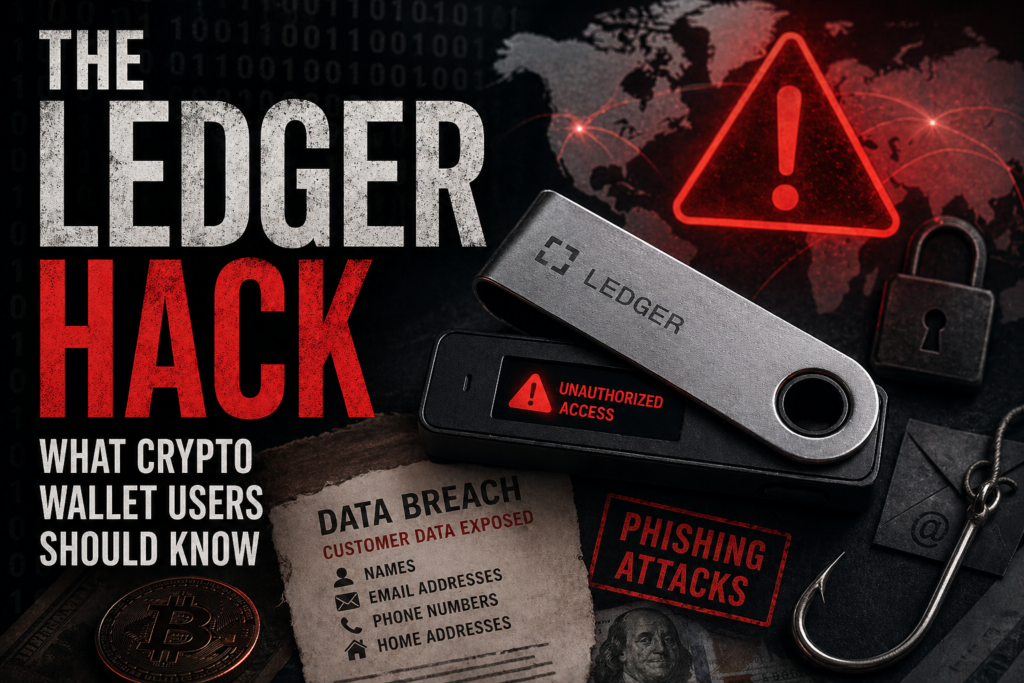
Ledger built its reputation on one promise: security. For years, cryptocurrency investors purchased Ledger hardware wallets because they believed the devices offered stronger protection than exchanges and software wallets. Ledger marketed its wallets as tools that kept private keys offline, isolated from hackers, malware, and third parties.
Then the controversies started.
Over the last several years, Ledger has faced a series of major security incidents involving customer data exposure, phishing attacks, software compromise allegations, and lawsuits challenging how the company marketed the security of its products.
For crypto investors, the Ledger [1]story matters because it exposes an uncomfortable truth: hardware wallets reduce some risks, but they do not eliminate them.
The 2020 Ledger Data Breach
In 2020, Ledger disclosed that hackers gained access to portions of its customer database. Public reports later indicated that the breach exposed more than one million email addresses and thousands of records containing names, phone numbers, and physical addresses.
That immediately created a serious problem.
Ledger did not sell ordinary consumer electronics. It sold hardware wallets designed specifically for cryptocurrency storage. The leaked data allegedly identified people likely holding digital assets.
Soon after the breach became public, Ledger users began reporting phishing emails, fake support messages, threatening text messages, and impersonation scams. Criminals allegedly used the stolen customer information to target crypto holders directly.
Some users reportedly received threats demanding cryptocurrency payments. Others encountered sophisticated phishing websites designed to trick victims into revealing their wallet seed phrases.
Once a scammer obtains a seed phrase, the wallet can often be restored instantly on another device. The cryptocurrency may disappear within minutes.
Why the Ledger Breach Was Different
Most data breaches involve passwords or credit cards. The Ledger breach allegedly exposed something far more valuable: a list of cryptocurrency holders.
That distinction matters.
Criminals increasingly target crypto investors through social engineering attacks. Instead of attacking blockchain cryptography itself, scammers manipulate victims into surrendering access voluntarily. They impersonate support staff, create fake wallet applications, clone legitimate websites, and send fraudulent “security alerts.”
The Ledger breach allegedly gave attackers a roadmap.
A criminal who knows someone purchased a hardware wallet may reasonably assume that person owns cryptocurrency. Add a phone number, email address, and physical address to the equation, and the risks escalate quickly.
The crypto industry has also seen increasing concern over so-called “wrench attacks,” where criminals use threats or physical force to obtain wallet credentials. Many Ledger users expressed concern that the breach exposed them to exactly that type of risk.
The Ledger Connect Kit Attack
Ledger faced another major controversy in December 2023.
Hackers compromised Ledger’s “Connect Kit,” a software library used by decentralized finance applications to connect with Ledger wallets. Reports indicated that attackers gained access through compromised employee credentials and pushed malicious code updates.
This was not a traditional wallet hack. It was a supply-chain attack.
Instead of targeting users one by one, attackers allegedly compromised trusted software infrastructure used across the crypto ecosystem. Users interacting with affected decentralized applications could unknowingly approve malicious transactions.
Reports later indicated that hundreds of thousands of dollars in cryptocurrency were stolen before the malicious code was removed.
The incident exposed a major weakness in the crypto ecosystem. Even if the hardware wallet itself remains secure, users still rely on:
- wallet software,
- browser extensions,
- firmware updates,
- decentralized applications,
- and third-party software dependencies.
The Ledger Recover Lawsuit
Ledger also became the target of a major class action lawsuit involving its “Ledger Recover” feature.
The lawsuit alleges that Ledger marketed its Nano wallets as devices where private keys could never leave the hardware wallet or be exposed to the internet. According to the complaint, Ledger repeatedly represented that users maintained complete and exclusive control over their private keys.
The controversy intensified in 2023 when Ledger introduced Ledger Recover, a feature designed to back up seed phrase information by encrypting it, splitting it into fragments, and distributing those fragments to third-party custodians.
Critics immediately questioned whether the feature contradicted Ledger’s prior marketing statements.
The lawsuit points to public statements allegedly made by Ledger claiming firmware updates could not extract private keys from the Secure Element chip. The plaintiffs further allege that Ledger later acknowledged it was technically possible to write firmware capable of facilitating key extraction.
Ledger disputes the allegations, and the litigation remains ongoing. Still, the case raises important consumer protection questions.
Consumers purchase hardware wallets because they believe the devices provide strong isolation and security. When a company markets a security product using absolute language, courts may closely examine whether those statements were accurate, complete, and non-misleading.
What Ledger Victims Should Do
Victims of cryptocurrency theft connected to Ledger devices or Ledger-related phishing attacks should act quickly. Early evidence preservation can make a major difference in both tracing efforts and potential legal claims.
Anyone who suspects their wallet has been compromised should immediately preserve all available evidence, including wallet addresses, transaction hashes, screenshots, emails, text messages, exchange records, support communications, and device backups. In many cases, blockchain tracing can help identify transfers to centralized exchanges, intermediary wallets, or decentralized bridges that may become important later in an investigation.
These cases often involve far more than a simple “hack.” Depending on the facts, victims may have claims involving negligent security practices, unauthorized account access, deceptive business practices, or failures to implement reasonable fraud protections. The technical nature of cryptocurrency investigations also means that critical evidence can disappear quickly if it is not preserved properly.
Victims should also proceed cautiously when searching for help online. The cryptocurrency industry has seen a surge in so-called “crypto recovery scams,” where fraudulent companies promise guaranteed recovery services in exchange for large upfront payments. In many situations, those operations simply target victims a second time.
Victims of cryptocurrency theft should speak with an experienced crypto recovery attorney [2]as soon as possible. These cases often involve blockchain tracing, exchange subpoenas, cybersecurity evidence, cryptocurrency litigation, and arbitration proceedings involving digital assets. The issues can become highly technical very quickly, particularly where phishing attacks, wallet compromises, social engineering schemes, or cross-border transfers are involved. Early legal intervention may help preserve critical evidence and identify potential recovery options.
Contact MDF Law
MDF Law represents victims of cryptocurrency fraud, account takeovers, wallet compromises, phishing attacks, SIM swap attacks, and cyber-enabled financial theft. Our attorneys investigate exchange security failures, unauthorized cryptocurrency transfers, wallet-related compromises, and blockchain tracing issues involving stolen digital assets.
If you lost cryptocurrency connected to a Ledger wallet, phishing attack, fake support communication, or suspicious wallet activity, you should preserve evidence immediately and speak with attorneys familiar with cryptocurrency investigations.
To speak with an attorney, contact or call 800-767-8040 for a free consultation.
- Ledger : https://www.ledger.com/
- crypto recovery attorney : https://mdf-law.com/crypto/
Source URL: https://mdf-law.com/ledger-hacking-recovery/